Artificial Debates
Time to Build Arguments

This blog is attempting to demonstrate how social science can help better understand questions about Artificial Intelligence. This post deals with what political science can tell us about what a populist backclash looks like — and what we can, and should do to prepare.
Oh, it also shows it is bound to come.
If interested in more, subscribe
Here Comes the Future, Part 1
Remember what the future of the internet used to look like?
“We are creating a world where anyone, anywhere may express his or her beliefs, no matter how singular, without fear of being coerced into silence or conformity… Governments of the Industrial World, you weary giants of flesh and steel… You are not welcome among us. You have no sovereignty where we gather.”
So read “A Declaration of the Independence of Cyberspace,” one of the defining documents of the early internet era. Written by John Perry Barlow and introduced at the Davos World Economic Forum in 1996, it appeared on an estimated 40,000 websites. The zeitgeist was clear: behold the rise of a technocratic elite! A smart, responsible, meritocratic class full of innocent-looking visionaries and humble humanists who will replace the old-school, power-hungry, manipulative politicians. Technology finally makes it possible that the future, created by these creative disruptors, will be so much better. Sounds familiar?
Didn’t quite turn out that way.
The internet did change the way we live — but not the way we organise our society. It is vital we remember how wrong those predictions were so that we do not step into the same river for the third time.
Here Comes the Future, Part 2
Because for the second time, we already did. The internet made it possible for institutions with social missions to arise “to give people the power to share and make the world more open and connected,” as Mark Zuckerberg said of Facebook. The social media revolution was supposed to democratise access and empower people. They did some of that, yes, but they also became vehicles of misinformation and bias reinforcement while simultaneously destroying much of the serious legacy press.
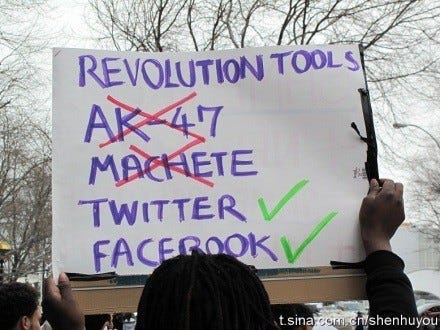
At first, it would seem that today’s technologists learned from the mistakes. The negative impact of the AI revolution is widely discussed. Yet if we look deeper, we see the same pattern. Predictions focus on technological trends. Sometimes they state certain economic or social consequences — but then consider their task completed. There will be a lot of job loss, and maybe inequality or an “AI arms race” between countries — so we should mitigate these consequences. But the blind spot is the same. It is called democracy and it is called politics.
All the Humans in the Loop
The data tells this story three times over.
In 2000, 65% of Americans said digital technology made the world a better place. By 2013, that had dropped to 51%. The research consensus on social media in 2009–2011 was uniformly positive: higher social trust, more civic engagement, no echo chambers. By 2022, 64% of Americans said social media had been bad for democracy — the highest negative number among 27 countries surveyed.
Now look at AI. In 2021, 37% of Americans said the increased use of AI in daily life made them more concerned than excited. By 2023, after ChatGPT’s launch, that jumped to 52%. By June 2025, concern held at 50%, with only 10% saying they were more excited. In February 2026, 40% predict AI will have a negative impact on society over the next twenty years, against just 16% who predict a positive one. Two-thirds (63%) say AI is advancing too quickly. Only 2% say too slowly. 71% believe AI will make their personal information less secure.
This is not an American anomaly. In the UK, a nationally representative survey of nearly 3,000 adults found 69% concerned about AI, against just 19% excited — and among the concerned, the feeling runs deep, with 55% describing themselves as “much more” concerned. 65% say AI is developing too fast. 85% want stronger laws to make AI safe; only 10% are confident in voluntary industry guidelines. Add that 68% believe AI will primarily benefit “the wealthiest households and corporations,” that AI company leaders are mostly negative figures in the public eye, and that just 10% think AI will benefit the working or middle class.
A humble note to AI company leaders. Unless their goal is specifically to make people … not like AI, it might be worth looking at what fellow billionaires do when they enter the national stage gto become politicians. They discover their humble origins. Suddenly care only about regular people. Forget they havew money. In fact, change wardrobe. Ridiculous, I know, but… works.
Meanwhile, the gap between expert opinion and public opinion is wider for AI than it was for either predecessor technology at comparable stages of adoption. In a paired study of AI experts and the general public, 47% of experts said they were more excited than concerned, compared to 11% of the public. 76% of experts said AI would benefit them personally; 24% of the public said the same.
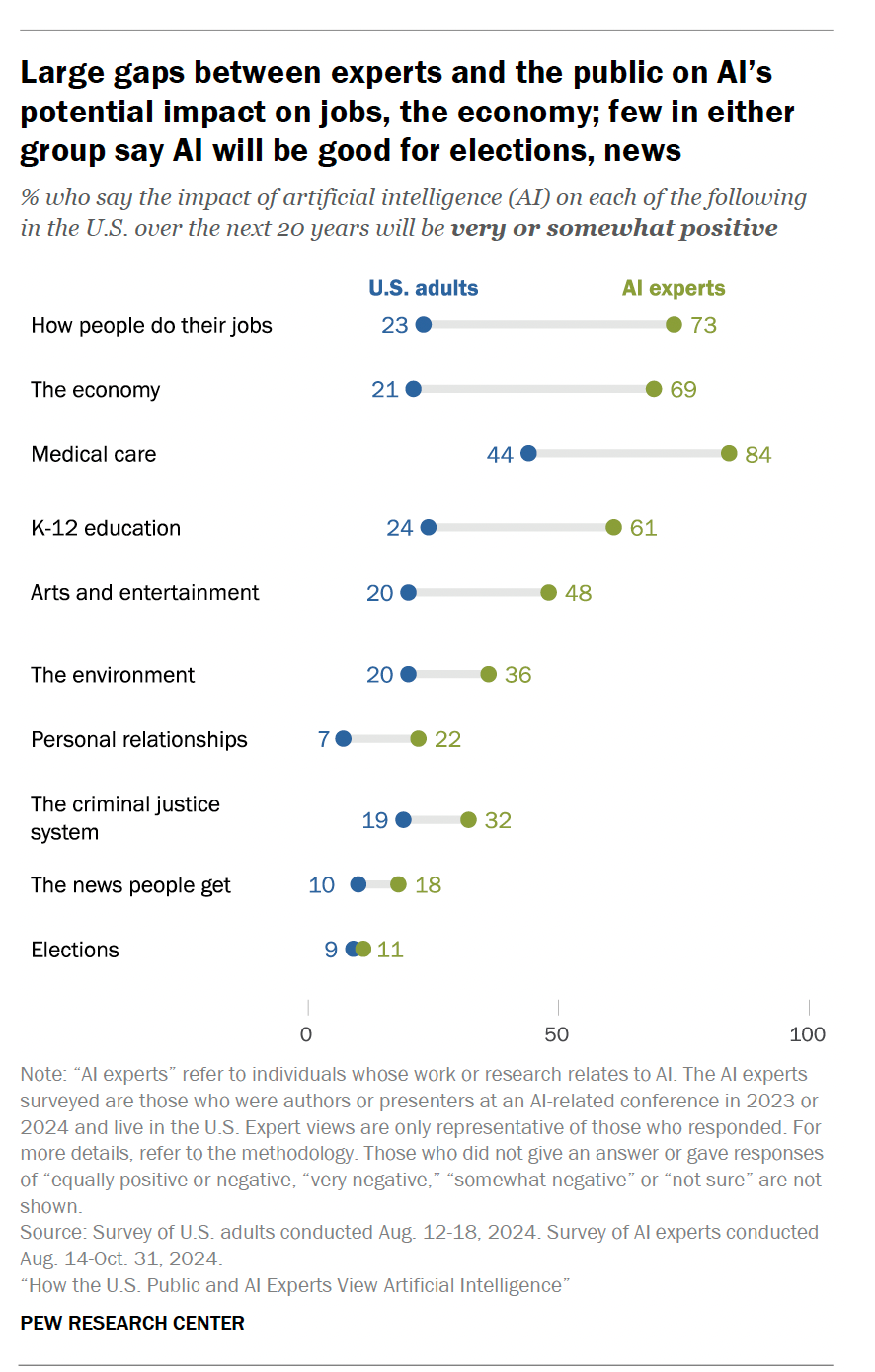
paired study by Pew
Artificial Populism
People are concerned about AI. They don’t like the companies making it. They think only the wealthy profit. They want their government to regulate AI, but don’t believe it will. Meanwhile, AI is omnipresent: everyone is an interested party. This is a textbook setup for a populist backlash. For someone to “show those companies” and give America back to humanity.
In the last year, the notion of such a backlash has started appearing in the AI governance literature. But the scenario envisioned there is, by the standards of democratic politics, a mild one. People will demand regulation and checks; if policymakers communicate well and offer smart, comprehensive responses, the situation can be managed.
I believe that to be a naive view. The backlash against AI is not going to be a spontaneous, uncoordinated, citizen-driven phenomenon. It is much more likely that an opportunistic political force will detect the potential of anti-AI sentiment and build a coordinated, professional movement around it. And a radical one. Not “let us regulate AI carefully” but “ban it.”
Prepare to be Irrational
There are three reasons I believe this message will arrive.
The first is about communication. In democratic politics, the radical position has a communication advantage over the moderate one. “They’re taking your jobs and we’ll stop them” beats “let’s design a thoughtful retraining programme” the same way “build a wall” beat “let’s have a managed immigration policy.” Before the advent of social media, elite condemnation mitigated that advantage. Now? Radical is the new normal.
The second, more fundamental reason is about the voters. The numbers bear this out. In the UK, the Alarmed Populists — 97% concerned, less than 1% excited, 89% saying AI moves too fast — and the Disengaged Traditionalists — 83% concerned despite only 31% having ever used AI — together make up 45% of the population. These segments do not need persuading. They need a vehicle. The moment a political movement offers one, the mobilisation is instant. On the other side, the most AI-friendly segment, the Hopeful Regulators, is split almost evenly between excitement (42%) and concern (46%). They will not march for AI. They will not show up at a town hall to defend a data centre. And even among this positive group, 95% believe AI leads to fake photos and videos, 68% believe it reduces privacy, and 44% say it threatens children’s safety. When a politician runs on banning AI, who exactly will argue against them?
The third is the most important.
AI is taking our jobs, increases inequality, enables terrorists to create weapons of mass destruction. Oh, and it poses existential risk to humanity. There is a logical, “common sense” question the populist would ask: why are we building it then?
Why are we building it?
And there is no answer. Because AI is framed as inevitable. Because the people designing AI systems see things very differently. But most importantly: because no one ever made the case for AI.
Consider: when Facebook appeared, it was cool to be on it. Twitter? Democracy, Arab Spring, citizen journalism.
Is it cool to use AI? Is it something we happily confess? The strategy of influencing only decision makers led to a situation in which it is shameful in polite society to confess using AI.
At best it is a necessary evil.
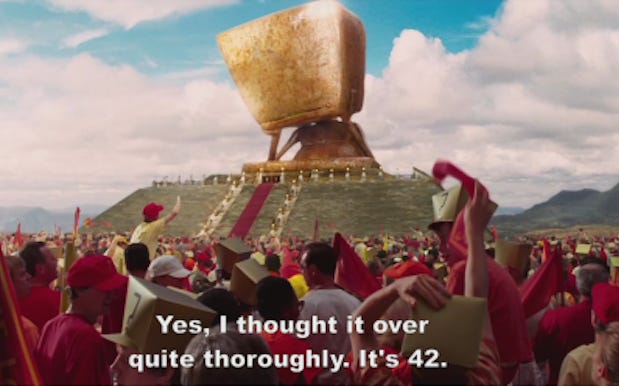
So once again, why are we building it, asks the populist. What is the meaning
Voters… Who Are They Again?
Once an issue becomes mainstream, it is transformed. Rational arguments are superseded by soundbites, identity politics, heuristics, and labels. Think abortion, immigration, campus protests, political correctness, minority rights. All of them had the potential to become mainstream: they evoke emotion, a relationship to the topic, and they are present in everyone’s lives. None of them became mainstream just by themselves. Political actors, sensing opportunity, channelled them in.
In a democracy, it is rarely wise to attempt to counter populist arguments by trying to come up with catchier or more reasonable arguments to show the inevitability of something.
And the fact that a policy hurts the very people supporting it should never be used as an argument — that happens all the time in politics.
Remember: the United States banned alcohol — a substance many people actually liked — for thirteen years. What happens when the target is a technology most people don’t think they need?
I am originally from Hungary. I know a thing or two about populism. IA populist tide sweeps away everything. Americans still cannot drink until they are 21, an institutional fossil from a policy reversed nearly a century ago.
AI has tremendous benefits. I remember my months spent in dusty libraries, trying to find out which scholar wrote about a topic I was struggling with. AI now creates a summary in ten minutes. Who would claim that this is bad? It can explain the theories of consciousness. It can hedge, avoid, and annoy. But makes my life easier.
The populist will attempt to destroy these arguments not on its merit sbut by claiming it helps the Evil Companies. Anyone making them is either paid for by them, or worse, just a useful idiot. And as AI companies are extremely unpopular, this association can indeed invalidate the argument.
Which is why it makes sense to introduce them before the backlash.
AI will either try to kill us or not. We won’t know for a while. There is also a lot of uncertainty about issues of job loss,
But half of all Americans now use AI. They have some experience with it, Some, good. Some, not so good. Experiences other people can relate to. I believe these experiences are a good place to start a reasonable debate.
If you would like more articles like